

Intensity Matters After Midlife


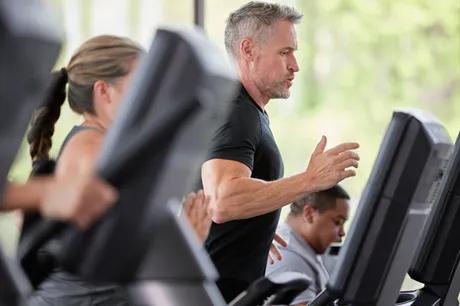
Personal trainers hold beliefs about aging that influence the intensity of exercise they recommend. A survey of 731 fitness professionals found that those with less experience are more likely to rate older adults as having lower physical capacity, underestimating their willingness and ability to engage in higher intensities.1 As a result, age-based judgments may limit capable members from progressing, even when they have the motivation and readiness to improve.
Challenge Common Assumptions
Progressive overload is necessary for improving fitness at any age. In fact, gradually increasing the intensity may be even more important for older adults because it can help reverse many of the cardiovascular risk factors associated with aging.
Arterial stiffness, a key risk factor for heart disease, refers to the loss of elasticity in the blood vessels that carry blood away from the heart. Healthy arteries expand and contract with every heartbeat, buffering the force of blood flow. As arteries stiffen, they lose that ability, increasing blood pressure and the heart’s workload. Exercise improves vascular function by reducing stiffness and lowering blood pressure.
Older Adults Have the Most to Gain
The heart and blood vessels begin adapting to higher exercise intensities within weeks and these benefits are often greater in older adults. This is because most adults over age 60 have already developed arterial stiffness and high blood pressure and both respond to cardio training.2 These changes are intensity-dependent, with higher intensities producing more robust improvements.2,3

Interval Training for Efficiency and Impact
High-intensity interval training (HIIT) is a time-efficient method that can reduce arterial stiffness in as little as four weeks.3 While more research is needed, strength training3,4 and yoga5 do not consistently impact arterial stiffness on their own. This suggests that weekly programming should include challenging intervals for the potent benefits to heart and blood vessel health.
HIIT sessions typically last 20-30 minutes, making them practical for members with limited time. Many research studies do not find moderate intensity workouts effective for reversing arterial stiffening, but a few do. Those workout sessions tended to be much longer, lasting about 50% longer than the typical HIIT session.6
What Fitness Professionals Should Do
Older adults not only tolerate higher-intensity training when it’s scaled appropriately, they also benefit more from it. This reminds us to avoid defaulting to low intensity based on age alone and instead, assess member abilities and interest for a personalized experience. A tailored, progressive approach can balance safety with a healthy challenge.
One of the most effective formats is HIIT delivered in a group setting. Supportive group dynamics and skilled instruction help older members feel capable, engaged and motivated to return.7 As one group member explained, “this form of short and intense exercise using such a small part of the day…it suits me perfectly.”
When older adults are met with appropriate challenges instead of assumptions, they show up with purpose, train harder and make meaningful progress.

Karlie Intlekofer, PhD, CNC, CPT
References
- Hawley et al. Are the attitudes of exercise instructors who work with older adults influenced by training and personal characteristics? J Aging Phys Act 2012; 20(1): 47-63.
- Slivovskaja et al. Aerobic training effect on arterial stiffness in metabolic syndrome. Am J Med 2018; 131(2): 148-55.
- Ashor et al. Effects of exercise modalities on arterial stiffness and wave reflection: A systematic review and meta-analysis. PLOS One 2014; 9(10): e110034.
- Figueroa et al. Impact of high-and low-intensity resistance training on arterial stiffness and blood pressure in adults across the lifespan: A review. Eur J Physiol 2019; 471: 467-78.
- Patil et al. Effectiveness of yoga on arterial stiffness. A systematic review. Complement Ther Med 2020; 52: 102484.
- Deiseroth et al. Exercise and arterial stiffness in the elderly: a combined cross-sectional and randomized controlled trial. Frontiers in Physiology 2019; 10: 1119.
- Fridberg et al. Negotiating a physically active life in tune with ageing: A grounded theory study of older persons’ experiences of participating in high intensity interval training. BMC Geriatrics 2025; 25: 11.

