

Reinventing a Classic: The Business and Biomechanical Benefits of Reclining Leg Extensions White Paper


Strength equipment that optimizes muscle function can help members achieve the results that maintain loyalty to their facility.
Gym Members Want Strength & Muscle
Surveys confirm that building strength and muscle is a top priority for many gym members. More than one in three¹ identify muscle growth as their primary goal, and over two-thirds² strength train regularly. Facilities have an opportunity to better support these members by providing more effective routines for strength and muscle growth. Beyond training volume and progression, equipment innovations can improve muscle activation and growth by leveraging biomechanics and research-driven design.
Balanced Quadricep Development Matters
Strengthening the quadriceps improves athletic performance and supports common aesthetic goals. More importantly, as the primary stabilizers of the knee, balanced quadricep growth reduces the risk of knee pain,3 injury,4 and osteoarthritis,5 leading causes of mobility decline that often cause members to scale back or stop training. Balanced quadricep growth helps members stay healthy and pain-free, supporting consistent facility visits and lowering the risk of membership attrition.
The Quadricep Muscles Explained
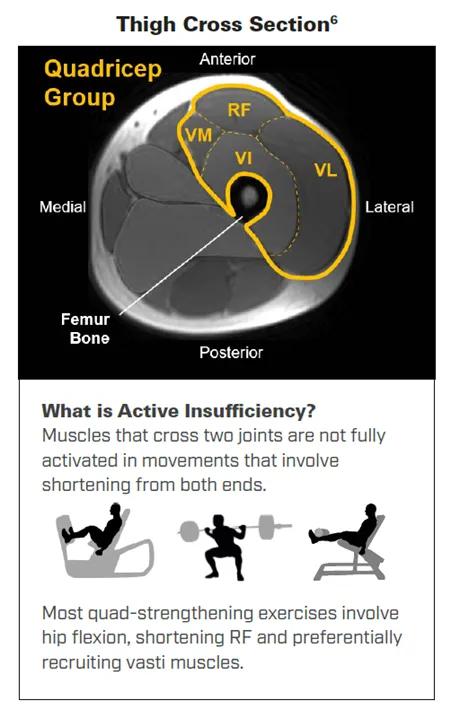
- Rectus Femoris (RF): A biarticular muscle (crosses both the hip and knee joint) that contributes to hip flexion and knee extension.
- Vastus Medialis (VM), Vastus Intermedius (VI), and Vastus Lateralis (VL): Three monoarticular muscles that cross the knee joint and contribute to knee extension.
What is Active Insufficiency?
Muscles that cross two joints are not fully activated in movements that involve shortening from both ends. Most quad-strengthening exercises involve hip flexion, shortening RF and preferentially recruiting vasti muscles.
Addressing VL Dominance
The vasti muscles (VM, VI, VL) cross the knee, but RF crosses both the hip and knee. As a result, common leg exercises fail to deliver balanced quad development. In fact, the back squat disproportionately grows the vasti with minimal RF hypertrophy,7 and the leg press increases VL size by five times that of the RF.8 This imbalance reflects RF active insufficiency; hip flexion shortens RF, restricting effective force generation and limiting RF improvements in strength and size.
Solutions: Targeting RF More Effectively
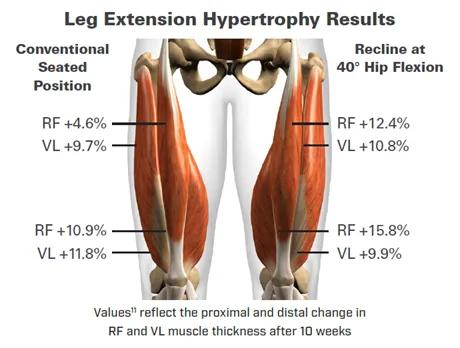
Sports scientists 9 emphasize that “the RF is a very difficult muscle to target and strengthen,” yet recent research identifies a promising solution. Activation of the RF muscle differs based on whether leg extensions are performed in either conventional seated or reclined positions, with reclining positions improving RF activation by reducing active insufficiency.10 While these findings confirm that hip flexion influences RF recruitment, the next question is whether this extends to superior RF muscle growth. To answer this, researchers compared changes in RF and VL muscle thickness after ten weeks of leg extension training in a conventional or 40° hip flexion (reclined) position.
Compared to conventional seated positions, the reclined position produced a 2.7-fold and 1.45-fold greater increase in proximal and distal RF thickness, respectively, as shown in the anatomical image.11 The researchers concluded that “when the goal is to increase overall quadriceps hypertrophy, we suggest training with reduced hip flexion in the leg extension exercise.” 11 This clarifies that while both positions increase RF and VL growth, conventional seated positions preferentially target VL while reclining to 40° or more preferentially targets RF.
Innovation for Balanced Quad Development
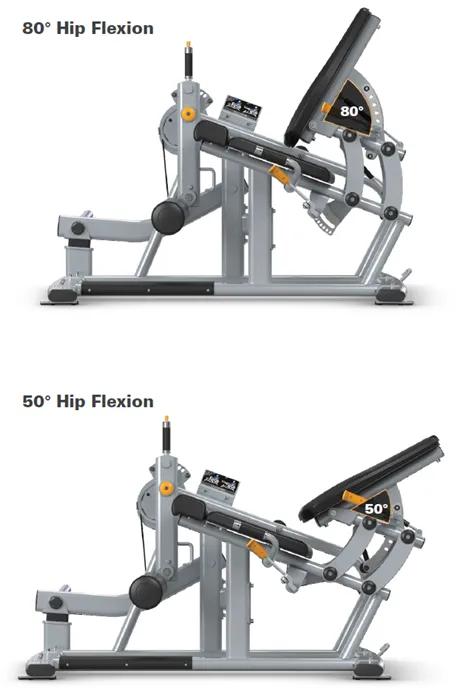
The evidence supporting reclined positions for balanced quad development led to the creation of the first commercially available leg extension equipment with the option of adjusting incrementally to 50° hip flexion, the MGPL73. A 50° reclined position was selected to improve RF recruitment while maintaining a supportive base of support. By reducing active insufficiency, this reclining adjustment enhances RF activation while still engaging the VL for balanced quadriceps development.
Member Advantages
This significantly advancement in leg extension equipment design addresses a long-standing limitation in RF activation and growth. Because the recline feature is adjustable, those who prefer a more upright seat position can continue to train as before. Members who use the recline function gain balanced quad strength and size more efficiently while also benefiting from improved knee stability and long-term joint health, both essential for member retention. In addition, customizable hip positioning and a wide seat surface improve accessibility for various body shapes and sizes.
Innovation Backed by Science
As strength training evolves, Matrix continues to lead with research-backed innovation. By integrating the latest biomechanics and sports science, our engineering team develops solutions that improve training effectiveness, helping facilities deliver smarter, more efficient strength and hypertrophy results to their members.
Learn more about the Magnum Plate-loaded Reclining Leg Extension

