

High Row Benefits: Movement Freedom, Independent Resistance, and Training Versatility


The Magnum High Row offers a distinct approach to upper body strength training, using a diagonal pulling path to target major muscles of the back and shoulders. Unlike traditional lat pulldowns or horizontal rows, the High Row combines a downward and backward pulling motion with rotating handles and independent resistance. These design features give members greater freedom of movement and more ways to train according to their individual needs, abilities and goals.
Muscle health is a priority for today's fitness consumer, with half of adults who set fitness-related goals saying they want to build muscle and strength.1 This creates an opportunity to provide equipment that helps more members train effectively, while giving them options as their goals and abilities evolve.
What Muscles Does a High Row Machine Work?
A complete strength program challenges all major muscle groups, including those of the back. Overhead pulling movements are very limited in everyday activities and require a specific focus. This is where the High Row shines.
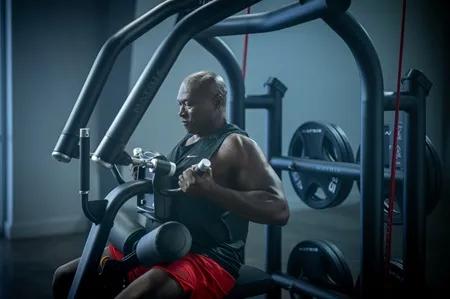
Pulling the arms down and back activates major muscles of the back and shoulders, including the rhomboids, trapezius, rear deltoids, and latissimus dorsi.2,3 This makes the High Row a valuable way to build upper-body pulling strength.
High Row vs. Lat Pulldown: Understanding the Movement Path
Strength coaches know that not every member has the same overhead range of motion. Even among adults without shoulder pain or stiffness, active shoulder flexion declines significantly with age 4. While some members can comfortably pull from a fully flexed shoulder position, others may benefit from options that better match their active range of motion.
The High Row offers a different approach to upper-body pulling that is distinct from the traditional lat pulldown or horizontal row. The arms travel down and back along a diagonal path, offering another way to challenge the back muscles with a movement path that accommodates more members.
How Rotating Handles Support Natural Movement
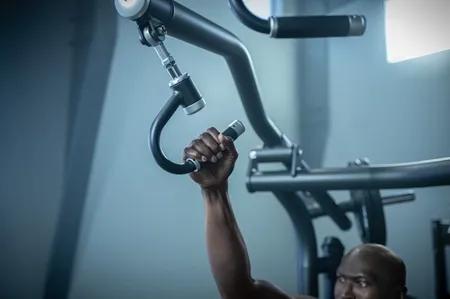
Rotating handles allow the hands and forearms to move more freely throughout the pull. Research has found similar latissimus dorsi activation across pronated, neutral, and supinated grips.5 As the elbows move down and back, some members may naturally rotate from a more pronated position toward neutral or slight supination.
Rather than prescribing one hand position, rotating handles allow the grip to follow each member’s natural rotation throughout the pull. Independent lever arms extend that movement freedom by allowing each side to work on its own.
Benefits of Independent Resistance in High Row Training
The High Row offers each arm independent resistance, allowing members to pull with both arms together, alternate sides, or train one arm at a time. These options allow the movement to adapt to individual needs and training goals.
The Science Behind Single-Arm Strength Training
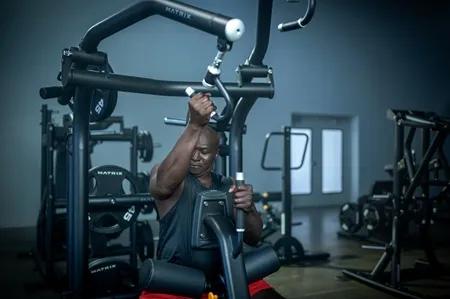
Single-arm training can also improve strength in the arm that does not exercise, which becomes of particular importance during periods of injury or immobilization. A meta-analysis found that training one arm increased strength in the opposite, untrained arm by 9.4%.6 More recent research confirms strength gains in the untrained arm without significant increases in muscle thickness7. This strengthening effect, called cross-education,8 shows that the benefits of training can extend beyond the limb doing the work, largely through changes within the nervous system.
Unilateral vs. Bilateral High Row Training
Independent resistance allows each arm to train at an appropriate load. If a member can comfortably use more resistance on one side, each arm can receive a meaningful challenge instead of letting one side determine the load for both.
Independent movement also provides options for training specificity. Unilateral training tends to produce greater gains in unilateral strength, while bilateral training favors bilateral strength.9,10 Members can train both arms together, independently, or in an alternating pattern depending on how they want to develop and express strength. Athletes may want an approach that more closely reflects how they produce force in their sport. For example, simultaneous pulling resembles the bilateral pattern used by rowers, while alternating pulls resemble patterns used by climbers, surfers, and kayakers.
Top Benefits of the Magnum High Row for Fitness Facilities
For a fitness facility owner or operator, these design features expand what one piece of equipment can offer and the number of members it can serve. Personalization does not always require another program, another machine, or another space. Sometimes better options can be built directly into the equipment.
A distinct pulling path, rotating handles, and independent lever arms give members and trainers multiple ways to approach the same upper-body pulling movement. These design features come together in the Magnum High Row to support a wider range of training needs and goals. A younger member focused on building muscle, an experienced lifter adding single-arm work, an older adult building strength for the years ahead, and a member who benefits from different loads on each side can find value in the same machine.
The High Row combines a distinct pulling path with the freedom to train both sides together or independently. These design features give more members more ways to build strength, progress toward their goals, and train with confidence across different abilities and stages of life.

Karlie Intlekofer, PhD, CNC, CPT
References
- Health & Fitness Association. Health, exercise, and fitness dominate Americans' New Year's resolutions. 2025. Nationally representative survey of 2,000 adults conducted by Kantar.
- Youdas et al. Recruitment of shoulder complex and torso stabilizer muscles with rowing exercises using a suspension strap training system. Sports Health 2021; 13(1): 85-90.
- Lehman et al. Variations in muscle activation levels during traditional latissimus dorsi weight training exercises: An experimental study. Dyn Med 2004; 3(1): 4.
- Gill et al. Shoulder range of movement in the general population: Age and gender stratified normative data using a community-based cohort. BMC Musculoskelet Disord 2020; 21(1): 1-9.
- Buonsenso et al. Electromyographic analysis of back muscle activation during lat pulldown exercise: Effects of grip variations and forearm orientation. J Funct Morphol Kinesiol 2025; 10(3): 1-11.
- Manca et al. Cross-education of muscular strength following unilateral resistance training: a meta-analysis. Eur J Appl Physiol 2017; 117(11): 2335-54.
- Hernando-Garijo et al. Cross-education of upper-limb strength and muscle thickness following unilateral resistance training: A systematic review and meta-analysis. Physiother Theory Pract 2026: 1-14.
- Intlekofer. Train One Side, Strengthen Both: The Advantages of Independent Movement. Matrix Research Hub 2026 [URL TBD].
- Kassiano et al. Comparison of muscle growth and dynamic strength adaptations induced by unilateral and bilateral resistance training: A systematic review and meta-analysis. Sports Med 2025; 55(4): 923-36.
- Xin et al. Comparative effects of unilateral versus bilateral training on performance adaptations: A systematic review and multilevel meta-analysis. BMC Sports Sci Med Rehabil 2026.

